
Views: 0 Author: Site Editor Publish Time: 2026-11-04 Origin: Site


Transitioning to autonomous cleaning equipment represents a high-stakes capital expenditure. Return on investment is strictly governed by operational uptime. A machine requiring constant manual intervention to recharge, or one that dies mid-route, negates the labor-saving benefits of automation and disrupts facility workflows. Facility managers must shift focus from superficial manufacturer specifications to a rigorous evaluation of commercial cleaning robot battery life. This requires examining the real-world variables, battery chemistries, and operational bottlenecks that dictate true autonomous runtime. Understanding how these machines consume power under actual facility conditions ensures you deploy equipment capable of completing the required routes without forcing human staff to constantly monitor the hardware. We will break down the exact power draw differences between scrubbers and sweepers, analyze how floor friction impacts discharge rates, and outline the infrastructure needed to keep your fleet running across multiple shifts.
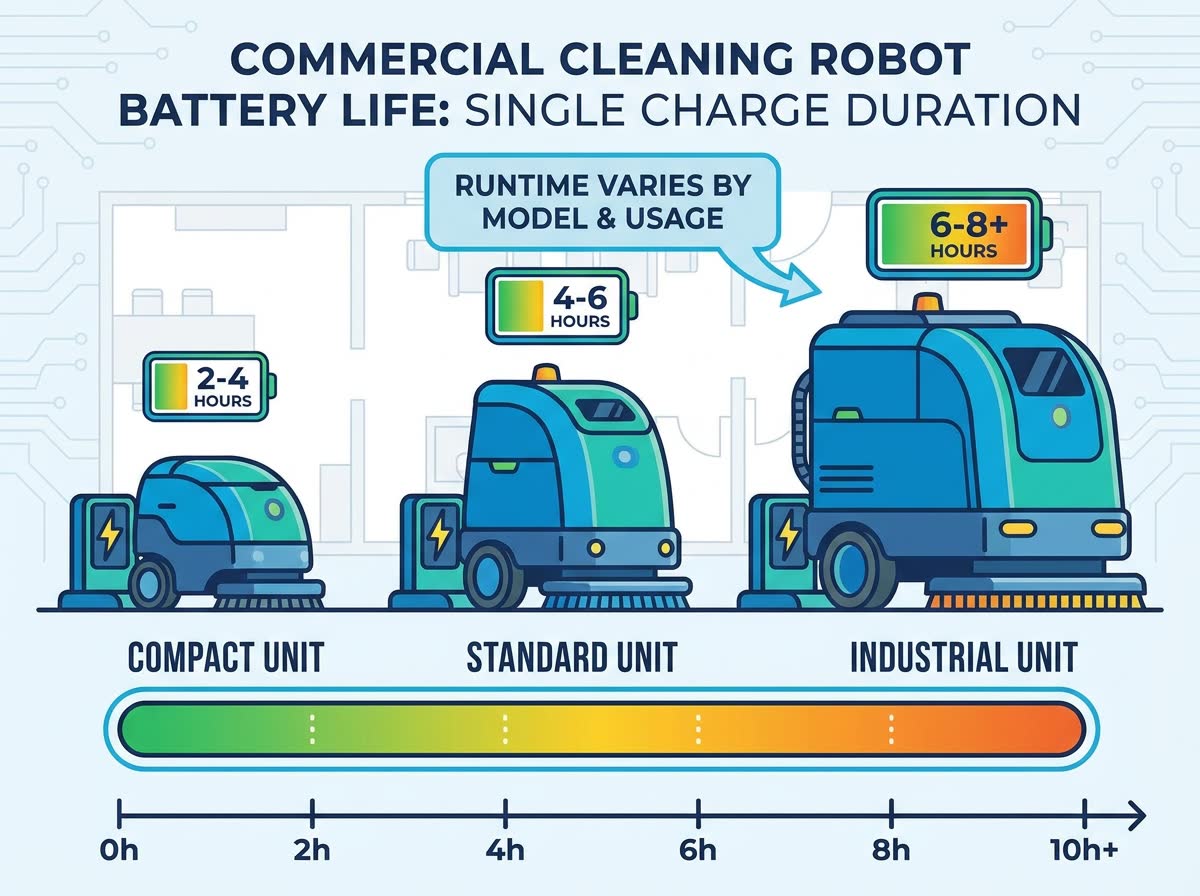
Baseline Runtimes: Most commercial cleaning robots operate between 3 to 6 hours on a single charge, heavily dependent on the machine type (scrubber vs. vacuum) and cleaning intensity.
The Chemistry Factor: Lithium-ion batteries dominate modern fleets due to faster charging and longer lifecycles, phasing out heavier, slower-charging lead-acid (AGM) alternatives.
The Co-Dependency of Consumables: Battery life is rarely the sole bottleneck; clean water capacity and recovery tank limits often force a pit stop before the battery is fully depleted.
Environmental Drain: Real-world facility conditions—such as floor friction, incline, obstacle density, and sensor power draw—can reduce theoretical battery performance by 15% to 30%.
Table of Contents
Different machine types draw power at vastly different rates based on their mechanical functions. Autonomous scrubbers represent the most energy-intensive category on the market. They require electricity to drive heavy traction motors, apply intense downward brush pressure, pump cleaning solution, and operate high-suction vacuum recovery systems simultaneously. A standard 24V or 36V scrubber system pulling power for all these components typically limits runtime to 3 to 4 hours per charge. The drive motor alone might pull 300 watts, while the vacuum motor pulls another 500 watts, and the brush deck pulls 400 watts. This combined load drains the battery pack rapidly.
Sweepers operate with far less electrical demand. They rely primarily on drive motors and rotational brush mechanics without the heavy burden of liquid recovery systems or water pumps. Consequently, autonomous sweepers often achieve 4 to 6 hours of continuous operation. Commercial robotic vacuums sit in the middle of the spectrum. They require significant power for suction motors to pull debris from carpets, usually resulting in a 3 to 5-hour operational window. Facility managers must match the machine type to the specific floor profile to establish accurate baseline expectations. A warehouse needing heavy scrubbing will burn through a charge much faster than a concourse requiring light sweeping.
Spec sheets often present a best-case scenario that rarely translates to the field. Manufacturers typically test equipment in highly controlled environments to determine maximum runtime. They run machines in uninterrupted straight lines across smooth, flat surfaces with minimal brush pressure and zero obstacles. Real facilities never mirror these sterile conditions. To avoid operational shortfalls, apply the 80% Rule during procurement. Plan for real-world uptime to be roughly 80% of the marketed maximum.
If a spec sheet claims five hours of continuous runtime, build your cleaning schedules around a reliable four-hour window. This buffer accounts for the inevitable environmental variables that drain power faster than laboratory tests suggest. When a robot encounters a blocked aisle, it stops, recalculates its path, turns, and accelerates again. Every one of those actions pulls a spike of amperage from the battery pack. Over a four-hour shift, those micro-draws add up, shaving significant time off the theoretical maximum runtime.
Floor composition directly influences electrical discharge rates. High-friction surfaces like commercial carpets or textured rubber flooring demand significantly higher torque from both drive and brush motors. The machine must work harder to propel itself forward and agitate dirt compared to gliding over polished concrete or vinyl composition tile (VCT). When a scrubber transitions from smooth concrete to a rubberized anti-slip mat, the brush deck encounters immediate resistance. The motors must draw higher amperage to maintain the programmed RPMs. Over a large facility, these high-friction zones act as a massive drain on the battery pack.
Topography adds another layer of energy consumption. Multi-level facilities, parking garages, and environments with ramps force the machine to fight gravity. Ascending an incline requires a massive spike in power output. Frequent transitions between different floor types or navigating uneven surfaces will noticeably shorten the operational window compared to cleaning a perfectly flat warehouse floor.
Floor Type | Friction Level | Estimated Battery Drain Impact |
|---|---|---|
Polished Concrete | Low | Baseline (0% reduction) |
Vinyl Composition Tile (VCT) | Low | Baseline (0% reduction) |
Textured Rubber Flooring | Medium | 10% - 15% reduction |
Commercial Carpet | High | 20% - 30% reduction |
Parking Garage Concrete (with inclines) | High | 25% - 35% reduction |
Autonomous machines rely on complex sensor arrays to navigate safely. Dynamic environments like busy warehouses with moving forklifts or retail stores with high foot traffic force the robot's LiDAR and AI systems to constantly recalculate routes. This continuous edge-computing requires a steady power draw. Every time a forklift crosses the robot's path, the machine halts. The drive motors stop, but the LiDAR spins, the 3D cameras process depth, and the onboard computer calculates a new trajectory.
Once the path clears, the drive motors require a surge of power to overcome inertia and get the heavy machine moving again. In a busy distribution center, this stop-and-go cycle happens hundreds of times per shift. The physical act of stopping, pivoting, and accelerating consumes far more energy than executing long, uninterrupted cleaning passes. A machine operating in a dense, obstacle-heavy layout will deplete its power reserves much faster than one cleaning wide-open aisles.
Operators frequently face a trade-off between cleaning efficacy and power preservation. Modern robotic scrubbers offer adjustable settings for suction power, downward brush pressure, and water flow rates. Engaging max-suction modes or applying heavy down-pressure for deep scrubbing requires the motors to draw maximum current. High water-flow settings also demand more energy from the internal pumps.
Running a machine on its most aggressive settings can reduce runtime by up to 30%. Facility managers should map out specific zones, applying heavy cleaning settings only in high-traffic entryways while utilizing eco-modes for lighter daily maintenance in secondary corridors. Adjusting these parameters based on actual soil levels prevents unnecessary battery drain.
The underlying chemistry dictates performance, weight, and longevity. Lithium-ion (Li-ion) and Absorbent Glass Mat (AGM) lead-acid represent the two primary options in modern fleets. Li-ion offers distinct operational advantages. It is significantly lighter, reducing the overall weight the drive motors must push. Li-ion also allows for a deeper safe Depth of Discharge (DoD) without damaging the cells, and it suffers from no memory effect.
While AGM batteries cost less upfront, they are heavier and degrade quickly if discharged too deeply. When evaluating long-term lifecycle value, Li-ion typically outperforms AGM by offering thousands of charge cycles compared to the few hundred cycles expected from lead-acid alternatives. The weight savings alone translate directly into longer runtimes per shift.
Feature | Lithium-Ion (Li-ion) | Lead-Acid (AGM) |
|---|---|---|
Weight Impact | Lightweight (reduces motor strain) | Heavy (increases power draw) |
Charge Speed | Fast (1-3 hours) | Slow (8-12 hours) |
Opportunity Charging | Supported without damage | Causes permanent degradation |
Cycle Life | 2,000 - 3,000+ cycles | 300 - 500 cycles |
Charging infrastructure dictates how quickly a machine can return to service. Opportunity charging involves plugging the robot in during short breaks, shift changes, or brief downtime windows. This practice is only viable with Li-ion systems, which accept rapid bursts of energy without chemical degradation. Fast-charging Li-ion systems can often reach 80% capacity in roughly two hours.
In contrast, AGM batteries require long, uninterrupted charging cycles—often overnight trickle charging lasting 8 to 12 hours. Attempting to opportunity-charge an AGM battery will permanently damage its capacity. Fast-charging capabilities allow a single Li-ion machine to cover multiple shifts that would otherwise require two separate AGM-powered units.
Charging methods directly impact labor requirements. Manual plug-in systems require a human operator to physically drive the machine to a charging bay, connect the cables, and monitor the process. This introduces the risk of human error, such as forgetting to plug the machine in at the end of a shift. Autonomous docking stations eliminate this labor burden.
The machine navigates itself to the dock when power runs low. However, auto-docking requires specific facility infrastructure. You must allocate dedicated space and install proper water lines, electrical hookups, and floor drainage to support fully autonomous draining, refilling, and charging cycles. Without adequate floor sinks and backflow preventers, autonomous docking cannot function safely.
Charging large industrial batteries daily impacts utility expenses. Facility managers must account for the electrical load required to maintain a robotic fleet. Smart charging strategies can mitigate these utility costs. By scheduling autonomous charging during off-peak electrical hours—typically late at night or early in the morning—facilities can take advantage of lower energy rates.
Advanced fleet management software allows operators to program these charging windows automatically. The robot can dock and remain dormant until the off-peak window begins, ensuring the battery reaches full capacity just before the next scheduled cleaning shift without incurring peak energy premiums.
Electrical capacity is rarely the sole bottleneck in autonomous cleaning. Consumables dictate operational reality. If a robot possesses a five-hour battery but only carries enough clean water for two hours of scrubbing, it still requires human intervention every two hours. The recovery tank filling up or the solution tank running dry forces a pit stop long before the battery depletes.
Facility managers must evaluate the ratio between electrical runtime and fluid capacity. Calculate the machine's water flow rate against the total square footage to determine true autonomous intervals. Matching battery capacity with tank capacity ensures you do not invest in electrical runtime you cannot physically use without stopping.
Manufacturers are addressing the fluid bottleneck through advanced filtration. Modern robotic scrubbers increasingly feature onboard water recycling systems. These systems filter the dirty water collected in the recovery tank, removing particulate matter and reusing the fluid for subsequent scrubbing passes.
These systems utilize multi-stage filtration, passing dirty water through coarse mesh screens, cyclonic separators, and fine micron filters before pumping it back to the solution tank. A machine equipped with a 20-gallon tank and a recycling system can effectively scrub as if it had a 100-gallon tank. This technology drastically extends the physical cleaning time, allowing the fluid capacity to match the electrical runtime. By implementing recycling systems, facilities can reduce the number of required pit stops, minimizing human intervention and maximizing the continuous autonomous operation of the machine.
Facilities operating around the clock, such as hospitals, airports, and logistics hubs, require uninterrupted cleaning capabilities. Hot-swappable battery architectures provide a viable solution for continuous multi-shift operation. Instead of parking the machine for hours to recharge, operators simply remove the depleted battery and insert a fully charged secondary unit. This keeps the hardware moving constantly.
However, this approach introduces logistical requirements. Industrial battery packs are heavy, often weighing over 50 pounds. Facilities must install proper lifting equipment or slide-out battery trays to prevent workplace injuries during the swap process. Operators also need clear protocols for inspecting the battery connectors for damage before inserting the fresh pack, ensuring continuous uptime without compromising workplace safety.
The primary goal of automation is reallocating human labor to higher-value tasks. You must map battery life directly to operational efficiency by calculating the exact hours of human labor freed up per charge cycle. If a robot cleans for four hours autonomously, that represents four hours a staff member can spend detailing restrooms, sanitizing high-touch surfaces, or managing waste removal.
To maximize productivity, structure human staff shifts around the robot's charging and operational windows. Deploy the robot to handle the wide-open concourses during peak cleaning hours, and schedule manual detailing tasks concurrently in adjacent rooms. When the robot docks to recharge, staff can transition to areas the machine cannot reach.
Managing a robotic fleet requires visibility into hardware performance. Fleet management software plays a critical role in tracking battery health, charge cycles, and gradual degradation over time. Modern dashboards display individual cell voltages, temperature warnings, and historical charge data.
Telemetry data provides real-time insights into power consumption patterns across different facility zones. If a machine suddenly starts draining 20% faster on its usual route, the software flags the anomaly. This data prevents unexpected mid-shift failures by alerting managers to failing cells or abnormal discharge rates before the machine dies on the floor. Predictive maintenance allows procurement teams to order replacement parts proactively, ensuring the fleet maintains optimal uptime and avoiding costly emergency service calls.
Chemical aging is an unavoidable reality. A robot will not deliver the same runtime in year three as it did in year one. As cells undergo hundreds of charge and discharge cycles, their maximum capacity naturally diminishes. Lithium-ion cells experience capacity fade. A pack rated for 100 amp-hours might only hold 85 amp-hours after two years of daily use.
Facility managers must account for this degradation when planning long-term cleaning schedules. A machine that barely finishes a route on a single charge today will likely require a mid-shift charge next year. Plan for this by budgeting for battery replacement cycles within the standard five-to-seven-year lifespan of the robotic hardware. Proactive budgeting prevents unexpected operational shortfalls as the equipment ages.
Hardware warranties often treat batteries as separate components with distinct coverage terms. Procurement teams must scrutinize manufacturer warranties specifically regarding the power source. Understand the difference between warranties based on calendar months versus those based on total charge cycles.
A three-year warranty might expire early if the machine exceeds a specified number of charge cycles during multi-shift operations. Clarify what constitutes a failed battery under the warranty terms—some manufacturers only offer replacements if the capacity drops below 70% within the coverage window. Read the fine print to avoid unexpected replacement costs, and ensure your maintenance team logs all charging data to validate any future warranty claims.
Human error remains a primary cause of premature battery failure. Poor operational habits destroy battery life faster than environmental factors. Common mistakes include leaving machines uncharged for weeks during facility closures, bypassing auto-docking protocols, or exposing machines to extreme temperatures in uninsulated storage areas. Mitigate these risks by implementing a strict standard operating procedure for daily maintenance and charging hygiene.
Inspect charging contacts daily for dirt, moisture, or corrosion before docking.
Ensure the machine is plugged in immediately at the end of every shift to prevent deep discharge.
Store and charge the equipment in a temperature-controlled environment away from direct sunlight or freezing drafts.
Report any sudden drops in runtime to the maintenance team immediately to catch failing cells early.
Calculate your required runtime based on cleanable square footage, shift structures, and floor types rather than defaulting to the largest available battery.
Request a multi-day on-site pilot program from vendors to map your facility and prove real-world performance under actual operational loads.
Audit your facility's infrastructure to ensure you have the necessary electrical, water, and drainage hookups to support autonomous docking stations.
Draft a standard operating procedure for daily charging hygiene and sensor cleaning to prevent premature chemical degradation.
A: Charging times depend heavily on the battery chemistry and charging infrastructure. Fast-charging lithium-ion systems can typically reach 80% capacity in roughly two to three hours. Standard lead-acid (AGM) batteries require slow, uninterrupted overnight trickle charging, which often takes between 8 to 12 hours to reach full capacity.
A: Coverage varies based on the machine's cleaning path width, travel speed, and environmental obstacles. A mid-sized autonomous scrubber typically cleans between 15,000 to 40,000 square feet on a single charge. Wide-area robotic sweepers operating in open warehouses can exceed 50,000 square feet per charge.
A: Replacement intervals depend on the chemistry and usage frequency. Lithium-ion batteries generally last for 2,000 to 3,000 charge cycles, often translating to three to five years of daily use. Lead-acid (AGM) batteries degrade much faster, typically requiring replacement every 300 to 500 cycles under heavy operational loads.
A: A single machine cannot run continuously for 24 hours without stopping. Facilities can achieve near-continuous operation by utilizing hot-swappable battery architectures, allowing operators to swap depleted batteries for fully charged ones instantly. Deploying multiple robots with autonomous docking stations also ensures one machine cleans while the other recharges.
A: Yes, extreme temperatures significantly impact battery chemistry. Operating in cold storage or sub-freezing warehouse environments slows down the chemical reactions within the battery, leading to faster discharge rates and reduced overall runtime. Facilities with cold storage must plan for shorter cleaning intervals and ensure machines charge in temperature-controlled areas.
A: Modern autonomous robots feature built-in fail-safes to prevent dying mid-route. When the battery drops to a critical threshold, the software triggers an automatic return-to-base protocol, navigating the machine back to its docking station. If a machine gets stuck and completely dies, operators must use manual recovery procedures to push it back.